AI/ML engineering · deep learning · LLM systems

Building AI systems — and checking that they work.

I’m Ansh Agrawal, a second-year B.Tech AI & ML student at Universal AI University. I build machine-learning, deep-learning and LLM applications — a graph neural network, calibrated classifiers, an agent pipeline and a retrieval system — and evaluate each one on held-out data before describing it.

  • 5 projects with case studies
  • 4 live demos
  • 5 recorded demonstrations

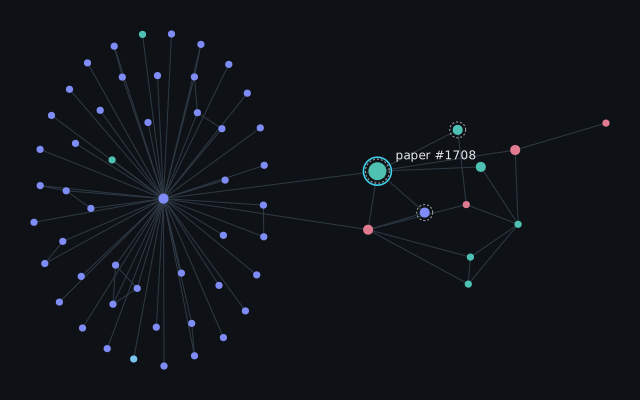
Background: 200 papers from the Cora citation graph, the data GraphMind classifies.

About

Applied ML, end to end

I work across the whole of an applied ML project: preparing data, training or orchestrating a model, serving it behind a small API, and building an interface someone else can actually use.

The step I care about most is evaluation — scoring the saved model rather than trusting a notebook printout, saying where every number comes from, and writing down what the system gets wrong. My current interests are graph learning, agentic LLM workflows and retrieval-augmented generation.

How these projects were built Each of the five projects started from a public tutorial. Each was then extended with a research-style interface, a re-evaluation of the shipped model or pipeline, deployment, and a written account of its limitations. Every case study lists what was added. The extensions were developed with the help of AI coding assistants; the evaluations and results were run and checked on the real systems.
Projects

Five systems, each with evidence

Every card links to a live demo or a recorded run and a full case study. Numbers carry a label showing where they come from — see how I evaluate. Source code is available on request. Live demos are hosted on Hugging Face Spaces.

Real citation neighbourhood of Cora paper 1708: 60 papers and 79 citation links coloured by true research topic, with dashed rings on test papers the GCN misclassifies.
01Live demo

GraphMind Research-topic classification with a graph neural network

A two-layer graph convolutional network assigns each of 2,708 papers in the Cora citation graph to one of seven topics, combining a paper’s own word features with those of the papers it cites or is cited by.

Test accuracy (1,000 papers)
0.792
re-evaluated
Same model, citations removed
0.678
ablation
  • PyTorch Geometric
  • ONNX Runtime
  • FastAPI
  • JavaScript / SVG
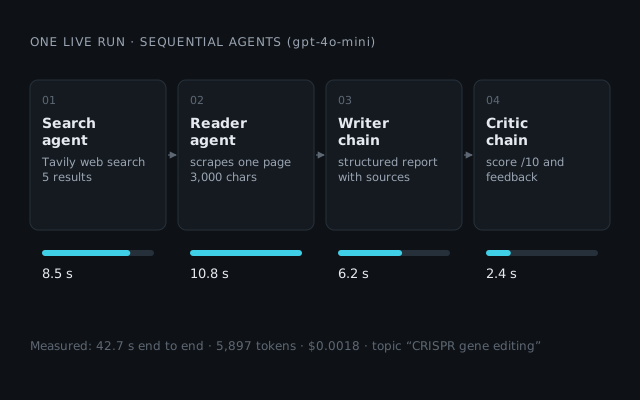
Scholaryx pipeline of four sequential agents with stage times measured in one live run: search 8.5 s, reader 10.8 s, writer 6.2 s, critic 2.4 s.
02Live demo · usage-limited

Scholaryx A sequential multi-agent research pipeline

A search agent, a reader agent, a writer chain and a critic chain turn a topic into a structured, sourced report with a self-critique. The public demo is rate-limited and its web scraper is protected against server-side request forgery.

End to end, two live runs
43 s / 28 s
measured
OpenAI cost per run
$0.0018
measured
Cited URLs found in sources
5 / 5
both runs
  • LangChain
  • OpenAI gpt-4o-mini
  • Tavily
  • FastAPI
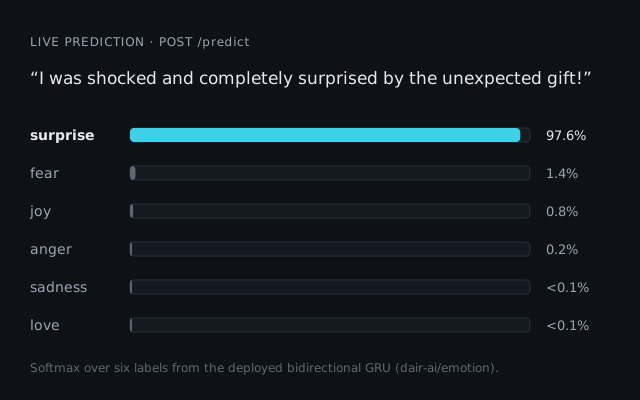
Moodalyx live prediction for “I was shocked and completely surprised by the unexpected gift!”: surprise 97.6 percent, fear 1.4, joy 0.8, anger 0.2, sadness and love below 0.1 percent.
03Live demo

Moodalyx Emotion-label prediction from short English text

A bidirectional GRU assigns one of six labels — sadness, joy, love, anger, fear or surprise — to a sentence and returns the full probability distribution, so uncertain predictions are visible.

Accuracy (2,000 test sentences)
0.921
re-evaluated
Macro-F1
0.880
optimistic: see case study
  • TensorFlow / Keras
  • Bidirectional GRU
  • FastAPI
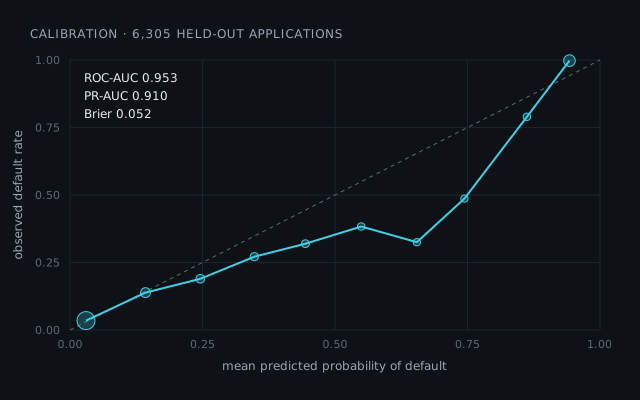
CreditCompass calibration curve on 6,305 held-out applications: observed default rate against mean predicted probability in ten bins, next to the diagonal for perfect calibration. ROC-AUC 0.953, PR-AUC 0.910, Brier 0.052.
04Live demo

CreditCompass Calibrated loan-default probability with XGBoost

A tuned XGBoost pipeline wrapped in sigmoid calibration estimates the probability that a loan defaults, and shows the default rate actually observed among held-out applicants with similar scores. A research demonstration, not a lending tool.

ROC-AUC (6,305 held out)
0.953
re-evaluated
PR-AUC (21.6 % defaults)
0.910
re-evaluated
Brier score
0.052
re-evaluated
  • scikit-learn
  • XGBoost
  • Probability calibration
  • FastAPI
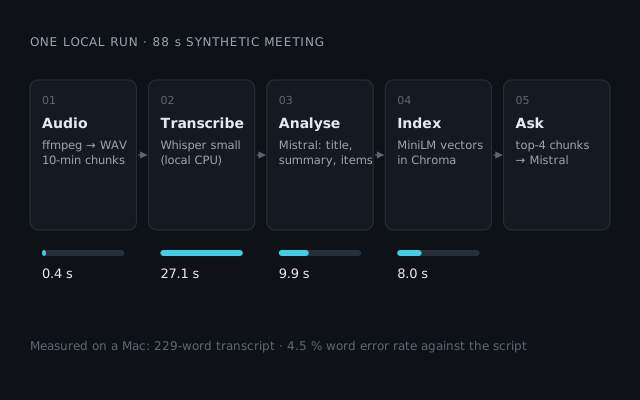
Verbalyx pipeline with stage times from one local run on an 88-second synthetic meeting: audio 0.4 s, transcription 27.1 s, analysis 9.9 s, indexing 8.0 s, then question answering over the top four retrieved chunks.
05Live demo · usage-limited

Verbalyx Question answering over what is said in a video

Extracts a video’s audio, transcribes it with Whisper, summarises it with Mistral, and answers questions from the four most relevant transcript chunks — showing that evidence next to every answer.

Word error rate, one 88 s synthetic meeting
4.5 %
single run
Questions answered correctly
3 / 3
one attribution error
  • Whisper
  • LangChain
  • Mistral
  • Chroma
  • FastAPI
Recorded demonstrations

Watch each system run

Screen recordings of real runs, each with a title and end card stating what was measured. They have no sound; a video loads only when you press play.

Recorded on the live site

GraphMind

Classifies paper 1708 and its two-hop neighbourhood, opens a misclassified test paper, runs the edge experiment, and scrolls through the evaluation computed by the server.

Recorded on the live site

Scholaryx

One real research run on “CRISPR gene editing” in real time: the four stages, the report, the critic’s score, the sources, and the measured tokens and cost.

Recorded on the live site

Moodalyx

Four sentences with their full probability distributions — including a real error (a happy sentence labelled fear) and a factual sentence forced into an emotion — then the test-split evaluation.

Recorded on the live site

CreditCompass

A typical application (3.5 %, low risk), a riskier one (94.8 %), an impossible input being rejected, the sensitivity tool, and the held-out evaluation.

Recorded locally · synthetic audio

Verbalyx

An 88-second synthetic meeting is transcribed, summarised and indexed; three questions are answered with retrieved evidence, including one about something never discussed.

Method

How I evaluate

A number is only useful if a reader can tell where it came from and what it leaves out.

01

Score the shipped artifact

Metrics are recomputed from the saved model files on the original held-out split, not copied from a single notebook run.

02

Label the provenance

Every figure is marked as re-evaluated, measured in a live run, or copied from notebook output.

03

Compare against something

A baseline or an ablation where one exists — a random forest without graph structure, the GCN without citation edges, logistic regression for credit risk.

04

Write down the failures

Data leakage, a checkpointing bug, a threshold chosen on the test set, and a speaker-attribution error are documented, including the ones not yet fixed.

re-evaluated recomputed from the saved model measured from a real run notebook copied from saved notebook output caveat read the limitation
Technical skills

What the projects use

Grouped by area, each linked to the project that demonstrates it.

Machine learning

  • scikit-learn pipelines
  • XGBoost
  • Randomized search
  • Probability calibration
  • Threshold analysis
  • Permutation importance

Used in CreditCompass

Deep learning

  • PyTorch Geometric (GCN)
  • TensorFlow / Keras
  • Bidirectional GRU
  • ONNX export & Runtime

Used in GraphMind, Moodalyx

NLP & speech

  • Text preprocessing
  • Tokenisation & sequence models
  • Whisper speech recognition
  • Word error rate

Used in Moodalyx, Verbalyx

LLMs & agents

  • LangChain agents & chains
  • Tool calling
  • OpenAI API
  • Mistral API
  • Tavily search
  • Prompt design

Used in Scholaryx, Verbalyx

Retrieval (RAG)

  • Chunking
  • Sentence-transformer embeddings
  • Chroma vector store
  • Grounded prompting

Used in Verbalyx

Evaluation

  • Held-out re-evaluation
  • Macro-F1
  • ROC-AUC & PR-AUC
  • Brier score & calibration error
  • Ablation

Used in all five projects

Engineering & deployment

  • Python
  • FastAPI
  • HTML / CSS / JavaScript
  • Git & GitHub
  • Hugging Face Spaces (Docker)
  • Render
  • GitHub Pages

Used in all five projects

Reliability & security

  • Input validation
  • Rate limiting
  • SSRF protection
  • Unit tests
  • Secret handling

Used in Scholaryx, CreditCompass

Experience

Roles

  1. Oct 2026 – present · part-time

    Industry Outreach Associate

    AI ConnectX · Universal AI University
  2. May 2026 – Jul 2026 · remote

    Artificial Intelligence Intern

    AI Cell, Universal AI University

    Built a university-focused AI chatbot using Python, retrieval-augmented generation and LLM APIs to help users find university information.

  3. Oct 2025 – Mar 2026 · part-time

    Member, Training Vertical

    AI Cell, Universal AI University

    Prepared the event documentation for two AI Cell training events: “AI Tools for Hackathon” and “Build Your Own Calling AI Agent Tool”.

  4. Dec 2025

    Member, AI in Village – Smart Project

    Light of Life Trust · Kushiwali, Karjat

    Collected community feedback and information through online forms in Kushiwali and nearby villages to support data collection on local needs.

Achievements · certifications · education

Credentials

Achievement · Sep 2026

1st place of 24 teams

Universal AI University internal hackathon for Smart India Hackathon 2026

Team Regnum Carya; my role was R&D. We proposed an explainable-AI design for diabetic-retinopathy screening — a design and pitch; the software is not yet built.

Certification · Jun – Oct 2026

Advanced AI Engineering

IIT Roorkee × Scaler

in progress

Certificate of completion · Sep 2026

Generative AI Mastermind

Outskill
Certificate · 2026

Master Python Programming

Udemy
Education · 2025 – 2029

B.Tech in Artificial Intelligence & Machine Learning

Universal AI University · School of AI & Future Technologies

Second year.

Contact

Get in touch

I’m looking for AI engineering and research internships. Source code for the five projects is available on request.